Dead Cat Bounce? Oil Prices After King Abdullah's Death

  • Subscribe to our RSS feed.
  • Twitter
  • StumbleUpon
  • Reddit
  • Facebook
  • Digg

Sunday, 6 July 2014

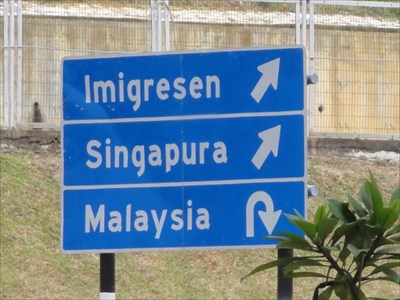
Overcrowded Singapore Spills Into Indonesia, Malaysia

Posted on 01:51 by Vicky daru
Move over Pearl River Delta for Sijori, the real Tri-State Area.
American readers, this being the IPE Zone, I ain't talking about New York-New Jersey-Connecticut. Asian readers, I ain't talking about China-Hong Kong-Macau (the Pearl River Delta) either since the latter two aren't "states." Instead, meet Sijori (Singapore-Johor-Riau) representing the three nation-states of Singapore-Malaysia-Indonesia at the heart of Southeast Asia.

I suppose it was inevitable that Singapore would get full up sooner or later. It is the world's second most densely populated country after the principality of Monaco (all 2 sq. km. of it). Sure they've been able to fiddle with this fact at the margins--over 20% of it is now built on reclaimed land, and most people already live in skyscrapers. However, there comes a point when people will no longer put up with ever-increasing costs for ever-shrinking residences. In other words, Singapore may already have hit its limit.

Like in the aforementioned Pearl River Delta, the beneficiaries are neighbors of overbuilt areas. Johor, Malaysia everyone knows about since its sultan sold Singapore to the British all those years ago, while Riau Archipelago, Indonesia is more of a recent beneficiary. At any rate, the new trend is for homebuyers to buy in neighboring Malaysia. Like in the US Tri-State Area, people commute across state lines to get to work and come home in the evening:
Darren Chin gave up a 15-minute train journey to his office in Singapore for a two-hour drive with a stop at passport control. The reason: By commuting from Malaysia, he can afford his own two-story home and car. “It’s worth it,” said the Malaysian financial adviser, who leaves his house before 6:45 a.m. to get to his job at OCBC on time. “I’m saving on rent and I’m paying for my own house.”

Chin is part of the expansion of Southeast Asia’s richest city across its borders as residents and companies seek property, labor and amenities, often at half the cost or less. The result is a three-nation urban complex with a population bigger than London and an economy that would rank as one of the fastest-growing in the region.

“Without the regional perspective it would be a lot more difficult, if at all possible, for Singapore to maintain the role that it has as a global city,” said Milica Topalovic, an associate professor at Future Cities Laboratory in Singapore. “Most of the pressing questions that Singapore has today -- of land, of workforce, of aging -- can be solved easily in a regional perspective.”

Combine the dominant forces of the 21st-century economy -- globalization and urbanization -- and the result is a metropolis that crosses borders, cultures and currencies. Southeast Asia’s prime example is known as Sijori, an acronym derived from Singapore, the neighboring Malaysian state of Johor, and Indonesia’s Riau Islands.
The sheer expense of living and construction in Singapore is driving a lot of this movement to more affordable locales:
For an island-state at its limits, access to land and labor in neighbors that were once arch-rivals is crucial. Economic growth and soaring immigration have strained Singapore’s resources, making it one of the most expensive places to live in the world. Singapore’s population density rose to 7,540 per square kilometer in 2013, closing in on New York’s 10,425. The Ion mall in the Orchard Road shopping district descends four stories into the ground, and the government is exploring building underground storage, transport hubs and shopping areas.

The island, whose $290 billion economy is bigger than that of Nigeria, the Philippines or Greece, has seen its population surge by almost a third in the past decade to 5.4 million. Add Johor and the Riau islands, and the number was about 10.1 million in 2010, according to estimates by Aris Ananta, a senior research fellow at the Institute of Southeast Asian Studies in Singapore. That could rise to 18 million by 2030, he said. 
What's more forecasts for the Sijori region to outperform Singapore alone--talk about spillover effects as thawing relations make closer economic ties possible:
The Sijori triangle’s economy will expand 5.7 percent annually in 2013-2020, compared with an average of 4.2 percent for Singapore, show forecasts by Toh Mun Heng, an associate professor at the National University of Singapore Business School.

Relations among the countries weren’t always cordial. Singapore and Malaysia were part of the same union for two years after independence from Britain until the city-state was ousted in 1965 by the leaders in Kuala Lumpur. Colonial bonds remained in the form of a pipeline from Malaysia that still supplies about half Singapore’s fresh water and a railway that ran across the island, but was owned by Malaysia until 2011. Those links caused decades of squabbles between the two nations as the fledgling countries competed in economic development. In 1997, former Singapore Prime Minister Lee Kuan Yew apologized after describing Johor as “notorious for shootings, muggings and carjackings.”
It's a pretty nice feelgood story about Southeast Asians collaborating profitably in time for our 2015 single market, but elsewhere the Sijori article points out that other matters need sorting out by the three nations involved such as border controls and transport infrastructure. Still, Singapore may transcend its main concerns--lack of space and lack of young people--by tapping those resources which its neighbors have in greater abundance.
Email ThisBlogThis!Share to XShare to Facebook
Posted in Southeast Asia | No comments
Newer Post Older Post Home

0 comments:

Post a Comment

Subscribe to: Post Comments (Atom)

Popular Posts

  • Detours to Linking HK, Shanghai Stock Exchanges
    The Hong Kong Stock Exchange has yet to be, ah, Shanghaied The recent turmoil over student protesters jamming the normal course of traffic (...
  • National Debt That's 245% of GDP? No Worries, Japan
    Relaaaaax; it's not as bad as it looks for Japan? Economics Professor Masazumi Wakatabe at Waseda University was prompted to write comme...
  • Professional Stand-In-Liners, a Venezuelan Profession
    "Everyday I dream dipeys don't run out once I finally get into the store." To be sure, professional waiters-in-line are not u...
  • Russia Fun: Ruling on $100B Yukos Expropriation Claim
    Those were the days--and some hope to bring them back. Five years later, we are about to hear the decision on Russia's liabilities from ...
  • East / Southeast Asia's Demographic Bifurcation
    There's are always interesting demographic discussions about the "West and the Rest," but there are also interesting demograph...
  • Dive Contest: Russian Ruble v Ukrainian Hryvnia
    Only the bravest would take a position on the RUB/UAH exchange rate. In the Summer Olympics, they have a popular and quite watchable event c...
  • China Has Exhausted Its Goodwill in SE Asia
    Call it "Escape From the Killing Fields 2": China sending ships to repatriate its workers from Vietnam as anti-PRC riots there re...
  • A Bad Idea: Flying Passenger Jets Over Ukraine
    I am greatly saddened by the loss of Malaysia Airlines MH17 over the airspace of Ukraine. I have been following the disaster since it was re...
  • Sands' Sheldon Anderson 1, Online Gambling Stateside 0
    The US nanny state and a casino mogul combine to frustrate online gambling Stateside. For a long time, I have covered attempts to regulate I...
  • Egypt's World Beggary Tour 2013 Goes On
    The rise and millennia-long fall of the Egyptian Empire continues apace. From the giddy heights of empire catalogued in the Bible to its pre...

Categories

  • Aerospace
  • Africa
  • Agriculture
  • Americana
  • Anti-Globalization
  • APEC
  • Caribbean
  • Cars
  • Casino Capitalism
  • Cheneynomics
  • China
  • Commodities
  • Corruption
  • Credit Crisis
  • CSR
  • Culture
  • Currencies
  • Demography
  • Development
  • Economic Diplomacy
  • Economic History
  • Education
  • Egypt
  • Energy
  • Entertainment
  • Environment
  • Europe
  • FDI
  • Gambling
  • Gender Equality
  • Governance
  • Health
  • Hegemony
  • IMF
  • India
  • Innovation
  • Intellectual Property
  • Internet Governance
  • Japan
  • Labor
  • Latin America
  • Litigation
  • Marketing
  • Media
  • Microfinance
  • Middle East
  • Migration
  • Mining
  • MNCs
  • Multiculturalism
  • Neoliberalism
  • Nonsense
  • Outsourcing
  • Paris Club
  • Religion
  • Russia
  • Sanctions
  • Security
  • Service Announcement
  • Socialism
  • Soft Power
  • South Asia
  • South Korea
  • Southeast Asia
  • Sports
  • Supply Chain
  • Technology
  • Trade
  • Travel
  • Underground Economy
  • United Nations
  • World Bank

Blog Archive

  • ►  2015 (16)
    • ►  January (16)
  • ▼  2014 (295)
    • ►  December (21)
    • ►  November (27)
    • ►  October (27)
    • ►  September (24)
    • ►  August (24)
    • ▼  July (28)
      • Can Malaysia Airlines Be Rebranded?
      • Marketing the Unmarketable: Israel's Soft Power
      • Is Russia on Argentina's Credit Highway to Hell?
      • In Memoriam: Japan's Export Champion Days
      • 'Libertarian Hacking' is Not an Oxymoron
      • Diversification, or Macau Can't Live on Gambling A...
      • Russia Fun: Ruling on $100B Yukos Expropriation Claim
      • Sisi's No Sissy: Ending Egypt's Unsustainable Subs...
      • Adios Sochi Grand Prix 2014, Russia World Cup 2018?
      • Bhagwati: PRC's Corruption 'Developmental', India'...
      • MNCs and Setting Cambodia's Minimum Wage
      • A Bad Idea: Flying Passenger Jets Over Ukraine
      • Diversifying Zambia's Copper-Based Economy
      • New World Order? BRICS "New Development Bank"
      • JP Morgan: How FIrms Can Profit From Using RMB
      • Tracing Tax Avoidance, Chicken Chain Style
      • World Cup of Default: Argentina at T-Minus 19
      • Referee Selection Politics: Germany v Argentina
      • Improving Governance, Secularizing Vatican Finances
      • When EU Membership's a Bust: Bulgarian Bank Run
      • Antitrust Biggies: Rockefeller 1911, Carlos Slim 2014
      • Tech Frontliners: Bangladesh's Traveling Infoladies
      • Does Gazprom Fund European Anti-Fracking Activists?
      • Overcrowded Singapore Spills Into Indonesia, Malaysia
      • Modern World Systems: Miami & Latin America
      • Social Media is a Wasteland, Corporate Edition
      • US Can Learn From Its Football Vanquisher, Belgium
      • PRC's Tech Jihad Vs. 'IOE': IBM, Oracle, EMC
    • ►  June (27)
    • ►  May (27)
    • ►  April (29)
    • ►  March (23)
    • ►  February (18)
    • ►  January (20)
  • ►  2013 (183)
    • ►  December (15)
    • ►  November (17)
    • ►  October (19)
    • ►  September (21)
    • ►  August (14)
    • ►  July (17)
    • ►  June (16)
    • ►  May (8)
    • ►  April (9)
    • ►  March (13)
    • ►  February (14)
    • ►  January (20)
  • ►  2012 (4)
    • ►  December (4)
Powered by Blogger.

About Me

Vicky daru
View my complete profile